Wheat Stem Cross Section Under the Microscope
Wheat Stem (Cross Section), Triticum aestivum
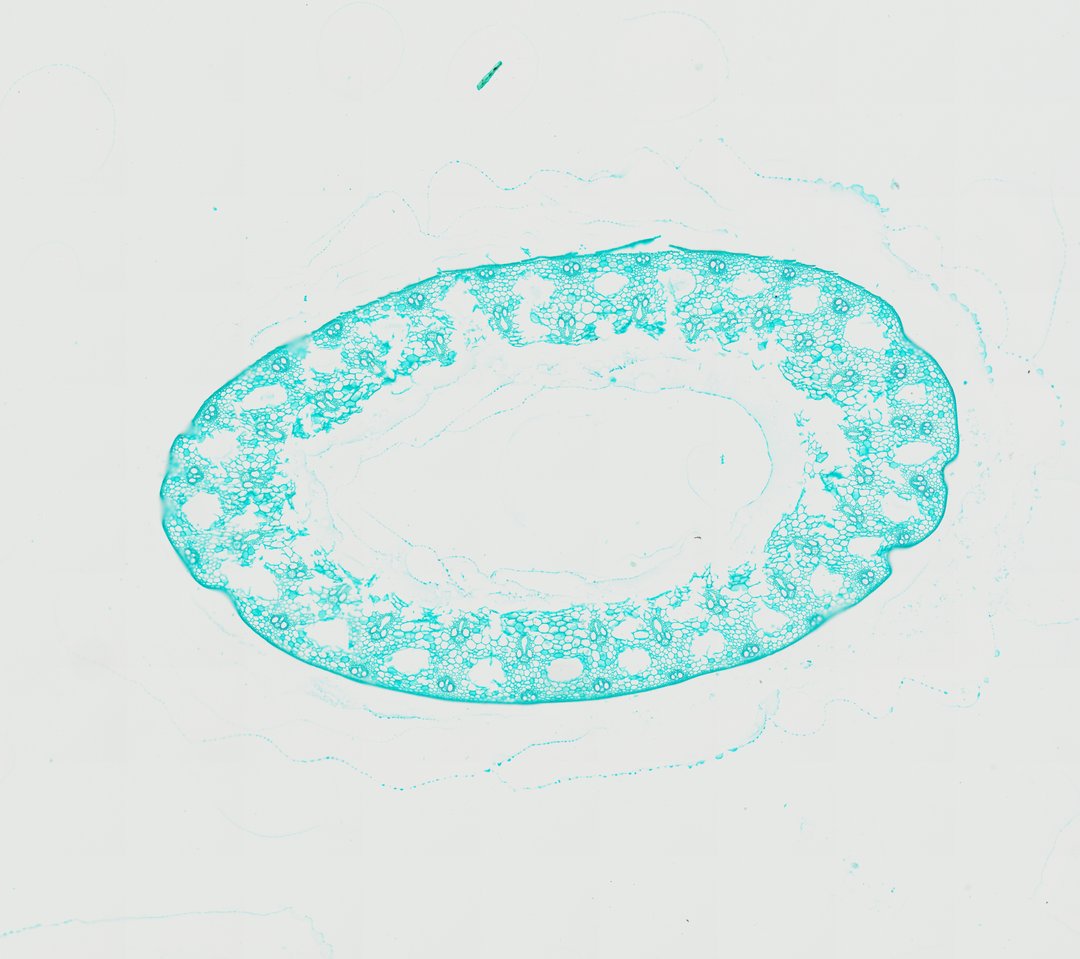
This is a cross section of a wheat stem stained with fast green. It is a classic grass stem, hollow in the middle with vascular bundles arranged in two rings.
This cross section of a wheat (Triticum aestivum) stem is stained with Fast Green. Like most grass stems, it is a hollow tube with a large empty space in the center. Scattered through the ring of ground tissue are vascular bundles, bundles of tubes that carry water and food. Each bundle has large xylem vessels that carry water, phloem that carries sugars, and a sheath of thick-walled cells for support. A band of tough, thick-walled cells just under the epidermis helps the stem stand tall and bend in the wind without breaking.
What to look for
- Hollow center: A large empty space in the middle of the stem.
- Epidermis: The outer layer of small cells.
- Sclerenchyma: Thick-walled strengthening cells just under the epidermis.
- Outer ring of bundles: Small vascular bundles near the outside of the stem.
- Inner ring of bundles: Larger vascular bundles deeper in the ground tissue.
- Bundle sheath: A ring of thick-walled cells around each bundle.
Questions and answers
Why are wheat stems hollow?
A hollow tube is strong for its weight. Grass stems like wheat use a hollow center with a strong outer ring of tissue, which lets them stand tall and bend in the wind without using much material.
What does a monocot grass stem look like under a microscope?
A grass stem like wheat is a hollow tube with vascular bundles in the ground tissue around the center. Each bundle has large xylem vessels, phloem, and a sheath of thick-walled cells.
Compare it
- Category
- Botany & Plants
- Scan magnification
- 20x
- Stain
- Fast Green
Viewing this slide in class
This is a scan of a real prepared slide, not a simulation or a drawing. On StudyScope you can pan from the whole slide down to individual structures, always in focus, and measure them in real micrometers with the calibrated ruler. Present it live and every student screen follows your view and annotations. Students join with a room code on Chromebooks, iPads, or any browser, with no accounts.