Sunflower Leaf Cross Section Under the Microscope
Sunflower Leaf (Cross Section), Helianthus annuus
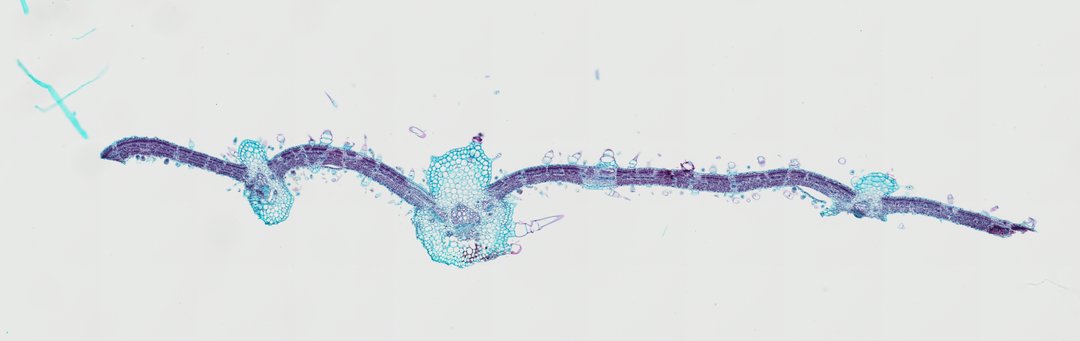
This is a cross section of a sunflower leaf stained with safranin and fast green. It shows the standard dicot leaf layers plus lots of hairs on the surfaces.
This cross section of a sunflower (Helianthus annuus) leaf is stained with Safranin and Fast Green. Many hairs, called trichomes, stick out from the upper and lower surfaces. The thick midrib in the center holds a large vascular bundle, with red-stained xylem that carries water and phloem that carries sugars. Inside the thin blade of the leaf, tall palisade cells packed near the top do most of the photosynthesis, while looser spongy cells below leave air spaces for gases. Students can compare the thin blade with the much thicker midrib and side veins.
What to look for
- Trichomes (hairs): Hairs made of several cells sticking out from the upper and lower surfaces.
- Epidermis: Single layers of cells on the top and bottom.
- Palisade mesophyll: Tall, tightly packed cells under the upper epidermis.
- Spongy mesophyll: Loosely arranged cells with air spaces toward the lower surface.
- Midrib: A large central vein with supporting tissue, red-stained xylem on top, and green-stained phloem below.
Questions and answers
Why are sunflower leaves hairy?
The hairs, called trichomes, can slow water loss, shade the leaf surface, and make the leaf harder for insects to eat.
What are the parts of a sunflower leaf cross section?
A sunflower leaf has an upper and lower epidermis with hairs, a palisade layer of tall cells, a spongy layer with air spaces, and a midrib with a large vascular bundle, xylem on top and phloem below.
Compare it
- Category
- Botany & Plants
- Scan magnification
- 20x
- Stain
- Safranin / Fast Green
Viewing this slide in class
This is a scan of a real prepared slide, not a simulation or a drawing. On StudyScope you can pan from the whole slide down to individual structures, always in focus, and measure them in real micrometers with the calibrated ruler. Present it live and every student screen follows your view and annotations. Students join with a room code on Chromebooks, iPads, or any browser, with no accounts.