Pine Cone Female Under the Microscope
Pine Cone Female (Longitudinal Section), Pinus
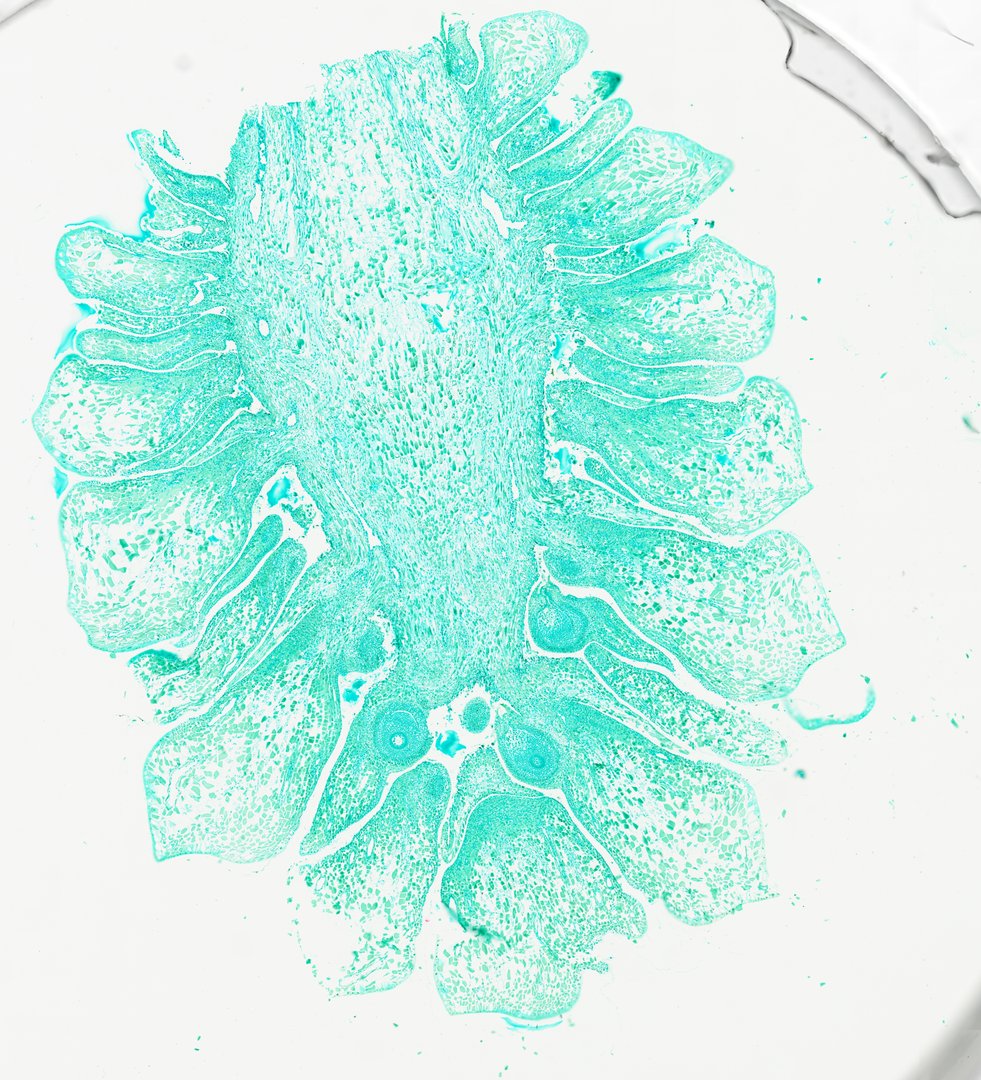
This is a lengthwise section of a young female pine cone stained with fast green. It shows where pine seeds begin, with ovules sitting on the cone scales.
This is a longitudinal section of a female pine cone (Pinus), stained with fast green. A thick central axis runs through the cone, and many scales branch off it in a spiral. Near the base of some of these scales, round ovules are visible, each with a dense center where the egg-making tissue forms. After pollination, these ovules grow into pine seeds. Students can compare this seed cone with a male pollen cone, which is smaller and makes pollen instead of ovules.
What to look for
- Cone axis: The central stalk running up the middle of the cone.
- Ovuliferous scales: Scales arranged in a spiral around the axis, which bear the ovules.
- Bract scales: Smaller scales just below each ovuliferous scale.
- Ovules: Oval structures on the upper surface of the scales, near the axis.
- Micropyle: A small opening at the end of each ovule where pollen enters.
- Female gametophyte: Tissue inside the ovule that will hold the egg cells.
Questions and answers
What does a female pine cone look like under a microscope?
A longitudinal section shows a central axis with scales arranged in a spiral. Each scale carries ovules on its upper side, and each ovule has a small opening, the micropyle, where pollen gets in.
What is the difference between male and female pine cones?
Male (pollen) cones are small and make pollen in pollen sacs. Female (seed) cones are larger and have ovules on their scales that become seeds after pollination.
- Category
- Botany & Plants
- Scan magnification
- 20x
- Stain
- Fast Green
Viewing this slide in class
This is a scan of a real prepared slide, not a simulation or a drawing. On StudyScope you can pan from the whole slide down to individual structures, always in focus, and measure them in real micrometers with the calibrated ruler. Present it live and every student screen follows your view and annotations. Students join with a room code on Chromebooks, iPads, or any browser, with no accounts.