Ligustrum lucidum Leaf Cross Section Under the Microscope
Ligustrum lucidum Leaf (Transverse Section), Ligustrum lucidum
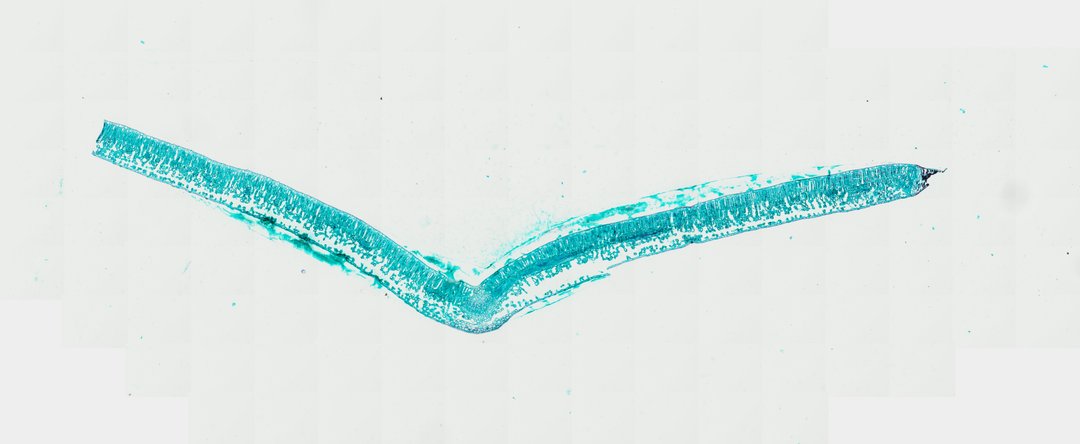
This is a cross section of a glossy privet leaf stained with fast green. It shows a thick midrib and the layers of a typical dicot leaf, with an extra-thick waxy coating on top.
This is a cross section of a glossy privet leaf (Ligustrum lucidum), stained green with fast green. The leaf is folded into a V shape, with the midrib, the thick main vein that carries water in and sugar out, at the point of the V. Under the upper surface is a row of tall, tightly packed palisade cells, where most photosynthesis happens. Below them are the loose, rounded spongy cells with air spaces between them, which let gases move through the leaf. Compare the tight upper layer with the open lower layer to see how a leaf is built for both catching light and trading gases.
What to look for
- Midrib: The thick central vein where the leaf blade is folded.
- Cuticle: A thick waxy layer on the upper surface that reduces water loss.
- Palisade mesophyll: Tall, tightly packed cells under the upper epidermis.
- Spongy mesophyll: Loosely arranged cells with air spaces toward the lower surface.
- Vascular bundles: Small veins with xylem and phloem spread along the blade.
Questions and answers
Why do some leaves have a thick cuticle?
A cuticle is a waxy layer that slows water loss. Evergreen leaves like privet stay on the plant all year, so a thick cuticle helps them survive dry or cold weather.
What is the midrib of a leaf?
The midrib is the main vein running down the center of a leaf. It holds the largest vascular bundle, which carries water in and sugar out, and it helps support the leaf blade.
- Category
- Botany & Plants
- Scan magnification
- 20x
- Stain
- Fast Green
Viewing this slide in class
This is a scan of a real prepared slide, not a simulation or a drawing. On StudyScope you can pan from the whole slide down to individual structures, always in focus, and measure them in real micrometers with the calibrated ruler. Present it live and every student screen follows your view and annotations. Students join with a room code on Chromebooks, iPads, or any browser, with no accounts.