Bird Feather Under the Microscope
Bird Feather (Whole Mount), Aves
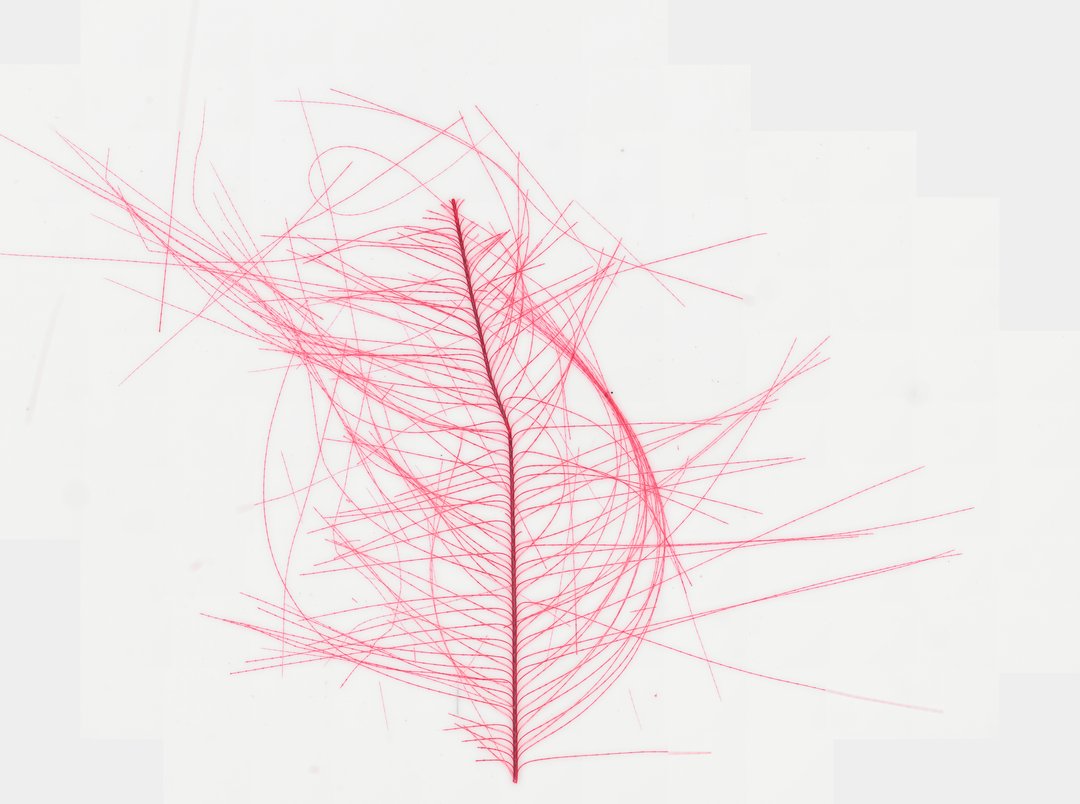
This slide shows part of a bird feather mounted whole and stained red. Students use it to see how feathers branch and hook together to form a smooth, strong surface.
This whole mount shows part of a bird feather, stained red so that its fine structure stands out against the background. A central shaft called the rachis runs up the middle, and thin branches called barbs grow out from each side. Even finer branches, the barbules, carry small swellings called nodes along their length. Long, loose barbules like these belong to a soft, downy feather, the kind that traps air to keep a bird warm. Like hair and nails, feathers are made of the protein keratin.
What to look for
- Rachis: The thick central shaft running down the middle of the feather.
- Barbs: Thin branches coming off both sides of the rachis, lined up in parallel rows.
- Barbules: Even smaller branches coming off each barb, giving a fuzzy or fringed look.
- Hooklets (barbicels): Tiny hooks on some barbules that catch neighboring barbules, like Velcro.
Questions and answers
What are the parts of a feather under a microscope?
A feather has a central shaft called the rachis, branches called barbs, and smaller branches off the barbs called barbules. Many barbules have tiny hooks that link them together.
How do feathers stay together?
Barbules on one barb have tiny hooks that catch onto barbules of the next barb, zipping them together. When birds preen, they are re-hooking barbs that have pulled apart.
What are feathers made of?
Feathers are made of keratin, the same kind of protein found in hair, nails, and scales.
- Category
- Vertebrates
- Scan magnification
- 20x
- Stain
- Red stain
Viewing this slide in class
This is a scan of a real prepared slide, not a simulation or a drawing. On StudyScope you can pan from the whole slide down to individual structures, always in focus, and measure them in real micrometers with the calibrated ruler. Present it live and every student screen follows your view and annotations. Students join with a room code on Chromebooks, iPads, or any browser, with no accounts.