Nostoc commune Under the Microscope
Nostoc commune (Whole Mount), Nostoc commune
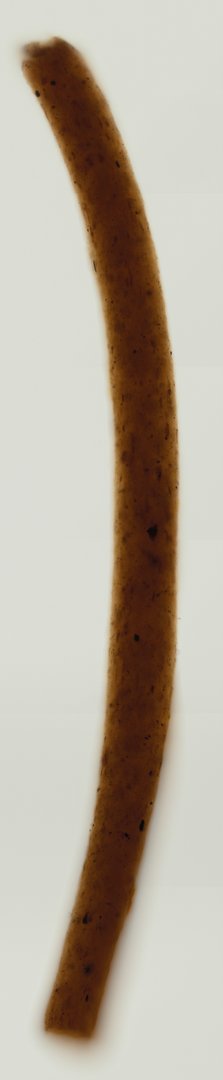
This slide shows Nostoc, a colony-forming cyanobacterium. Its bead-like chains of cells include special cells that capture nitrogen from the air, which makes it a great example of how bacteria can help feed ecosystems.
This is a whole mount of Nostoc commune, a cyanobacterium, which is a kind of bacteria that makes its own food by photosynthesis. Nostoc grows as colonies of bead-like cell chains packed inside a thick jelly. On this slide, a strip of the colony shows up as a long brown band, and the jelly is so dense that single cells are hard to pick out. Some cells in the chains, called heterocysts, take nitrogen from the air and turn it into a form living things can use. The jelly helps Nostoc survive drying out.
What to look for
- Filaments (trichomes): Chains of round to barrel-shaped cells, like strings of beads, often tangled together.
- Vegetative cells: The ordinary cells that make up most of each chain.
- Heterocysts: Slightly larger cells with thicker walls, spaced along the chains, where nitrogen is captured.
- Gelatinous matrix: A jelly-like material surrounding the filaments and holding the colony together.
- Akinetes: Larger, thick-walled resting cells that may be present.
Questions and answers
What does Nostoc look like under a microscope?
Nostoc looks like tangled strings of beads inside a clear jelly. Each bead is a cell, and every so often a slightly larger, thicker-walled cell called a heterocyst appears in the chain.
What are heterocysts?
Heterocysts are special cells in some cyanobacteria that take nitrogen gas from the air and turn it into a form living things can use. They keep oxygen out, because oxygen would stop that process.
Is Nostoc an alga?
Nostoc is a cyanobacterium, which is a type of bacterium. It photosynthesizes like algae and was once called blue-green algae, but its cells have no nucleus.
Compare it
- Category
- Microbiology
- Scan magnification
- 20x
Viewing this slide in class
This is a scan of a real prepared slide, not a simulation or a drawing. On StudyScope you can pan from the whole slide down to individual structures, always in focus, and measure them in real micrometers with the calibrated ruler. Present it live and every student screen follows your view and annotations. Students join with a room code on Chromebooks, iPads, or any browser, with no accounts.