Planaria Cross Section Under the Microscope
Planaria (Transverse Section), Dugesia
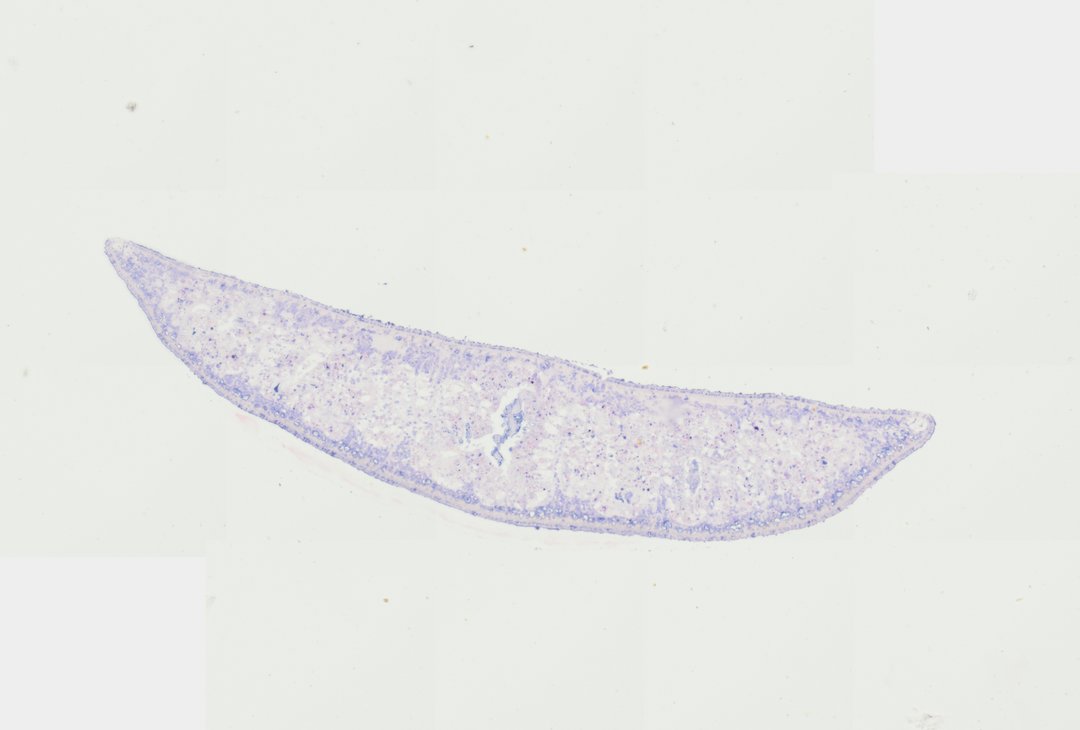
This is a cross section of a planarian, a small freshwater flatworm. Planarians have no body cavity and a branched gut, and they are famous for their ability to regrow lost body parts.
This is a transverse section (cross section) of a planarian flatworm (Dugesia). The body is thin and flat, which lets oxygen reach every cell by diffusion, and a thin outer layer called the epidermis covers it. Inside, there is no open body cavity, so planarians are called acoelomates. Instead, loose tissue called parenchyma fills the space around the small open channels, which are branches of the gut where food is digested. Students can compare this solid body plan with the fluid-filled body cavity of an earthworm.
What to look for
- Flattened body: A section that is wide and thin, since flatworms are flattened from top to bottom.
- Epidermis: A single outer layer of cells, with cilia on the underside for gliding.
- Muscle layers: Thin layers of muscle just under the epidermis.
- Parenchyma: Loose tissue filling the body, since planarians have no body cavity.
- Gut branches: Several spaces lined with cells, which are cross sections of the branched gut.
Questions and answers
What does a planarian cross section look like under a microscope?
A planarian cross section is flat and oval, with an outer epidermis, thin muscle layers, and loose tissue filling the body. Several small cavities are cut through the branches of its gut.
What does acoelomate mean?
Acoelomate means having no body cavity. In flatworms like planaria, the space between the gut and the body wall is filled with solid tissue instead of a fluid-filled cavity.
Why are planarians used in science?
Planarians can regrow a whole body from a small piece. Scientists study them to learn how stem cells rebuild tissues.
Compare it
- Category
- Invertebrates
- Scan magnification
- 20x
Viewing this slide in class
This is a scan of a real prepared slide, not a simulation or a drawing. On StudyScope you can pan from the whole slide down to individual structures, always in focus, and measure them in real micrometers with the calibrated ruler. Present it live and every student screen follows your view and annotations. Students join with a room code on Chromebooks, iPads, or any browser, with no accounts.