Butterfly Leg Under the Microscope
Butterfly Leg (Whole Mount), Lepidoptera
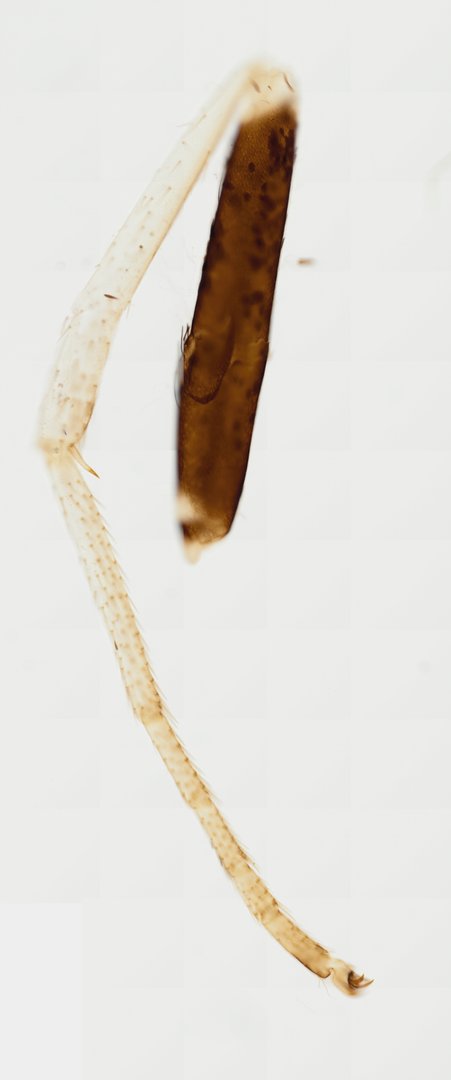
This is a butterfly leg mounted whole on a slide. It shows the jointed segments shared by all insect legs, plus scales and sensory hairs.
This whole mount shows a butterfly leg (order Lepidoptera) in its natural color. The leg is made of long, jointed segments covered by a hard, amber-colored exoskeleton. Rows of short spines and fine hairs line the segments, and many of these hairs sense touch. The last segments form the foot, called the tarsus, which ends in a pair of curved claws for gripping. Students can find the joints between segments and see how an insect leg bends.
What to look for
- Femur: A long, thick segment near the body end of the leg.
- Tibia: The next long segment, joined to the femur at a bend.
- Tarsus: A chain of small segments that make up the foot.
- Tarsal claws: A pair of small, curved hooks at the tip of the leg for gripping.
- Scales and hairs: Tiny flat scales and fine hairs covering the amber-colored cuticle.
Questions and answers
What are the parts of an insect leg?
An insect leg has the coxa and trochanter near the body, then a long femur, a long tibia, and a foot made of small segments called the tarsus, ending in claws. A butterfly leg shows these segments clearly.
Can butterflies taste with their feet?
Yes. Butterflies have taste receptors on their feet, which help them test whether a leaf is the right plant to lay eggs on.
- Category
- Invertebrates
- Scan magnification
- 20x
Viewing this slide in class
This is a scan of a real prepared slide, not a simulation or a drawing. On StudyScope you can pan from the whole slide down to individual structures, always in focus, and measure them in real micrometers with the calibrated ruler. Present it live and every student screen follows your view and annotations. Students join with a room code on Chromebooks, iPads, or any browser, with no accounts.