Daphnia Under the Microscope
Daphnia (Whole Mount), Daphnia
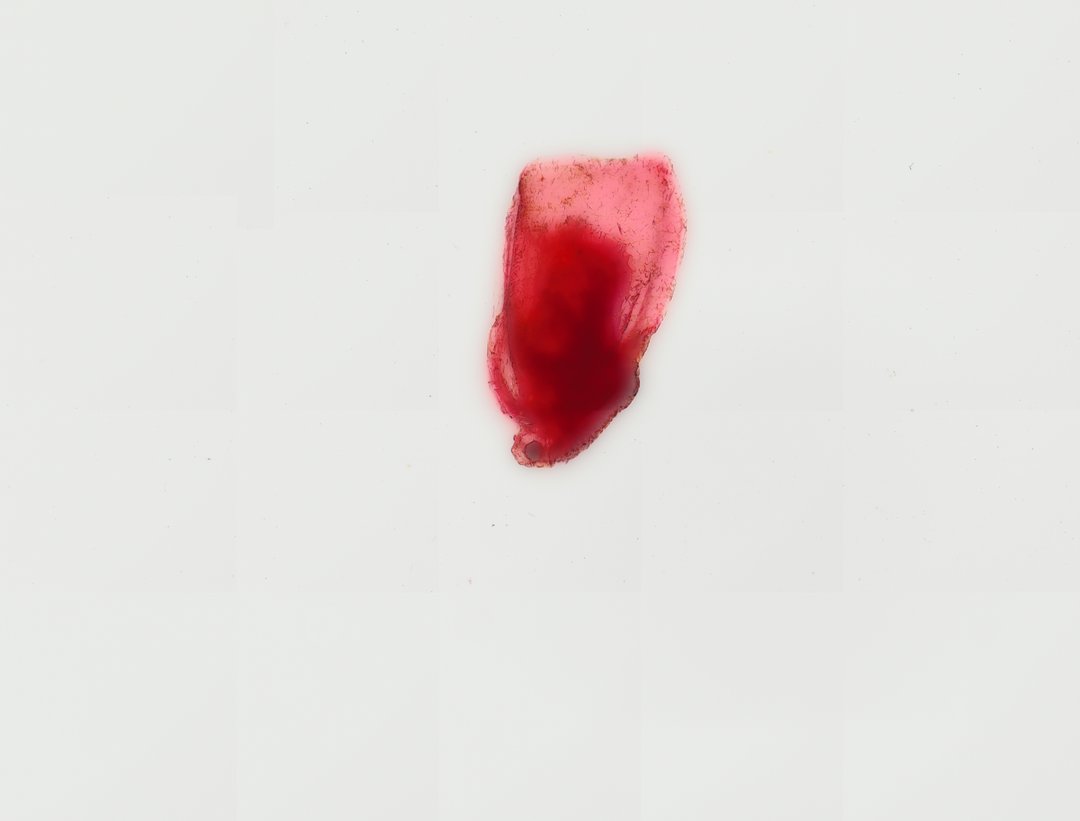
This is a whole Daphnia, or water flea, stained with carmine. Daphnia is a small see-through crustacean from ponds, and its clear body lets you see internal organs without cutting it.
This whole mount shows a Daphnia, or water flea, stained red with carmine. Daphnia is a tiny freshwater crustacean, related to crabs and shrimp. Its body sits inside a clear shell called the carapace, which shows here as the pale pink edge. The dark red mass inside is the stained body and organs, packed too tightly on this slide to pick out one by one. Daphnia is an important food for small fish, and it helps keep ponds clear by filtering tiny algae out of the water.
What to look for
- Carapace: A clear shell that wraps around the body but leaves the head free.
- Compound eye: A single dark eye near the front of the head.
- Second antennae: Large branched antennae used like oars for its jerky swimming.
- Digestive tract: A tube running through the body, often curved at the front.
- Heart: A small organ on the back, just behind the head.
- Brood chamber: A space on the back under the carapace where eggs or young may be held.
Questions and answers
What are the parts of a Daphnia under a microscope?
Daphnia has a clear carapace, a single compound eye, large branched antennae for swimming, a digestive tract, a heart on its back, and a brood chamber where eggs develop. Its legs are inside the carapace and are used for filter feeding.
Why is Daphnia used in biology labs?
Daphnia is transparent, so you can watch its heart beat and its gut work in living specimens. Classes often use live Daphnia to test how temperature or chemicals change heart rate.
Compare it
- Category
- Invertebrates
- Scan magnification
- 20x
- Stain
- Carmine
Viewing this slide in class
This is a scan of a real prepared slide, not a simulation or a drawing. On StudyScope you can pan from the whole slide down to individual structures, always in focus, and measure them in real micrometers with the calibrated ruler. Present it live and every student screen follows your view and annotations. Students join with a room code on Chromebooks, iPads, or any browser, with no accounts.