Mosquito Wings Under the Microscope
Mosquito Wings (Whole Mount), Culex pipiens
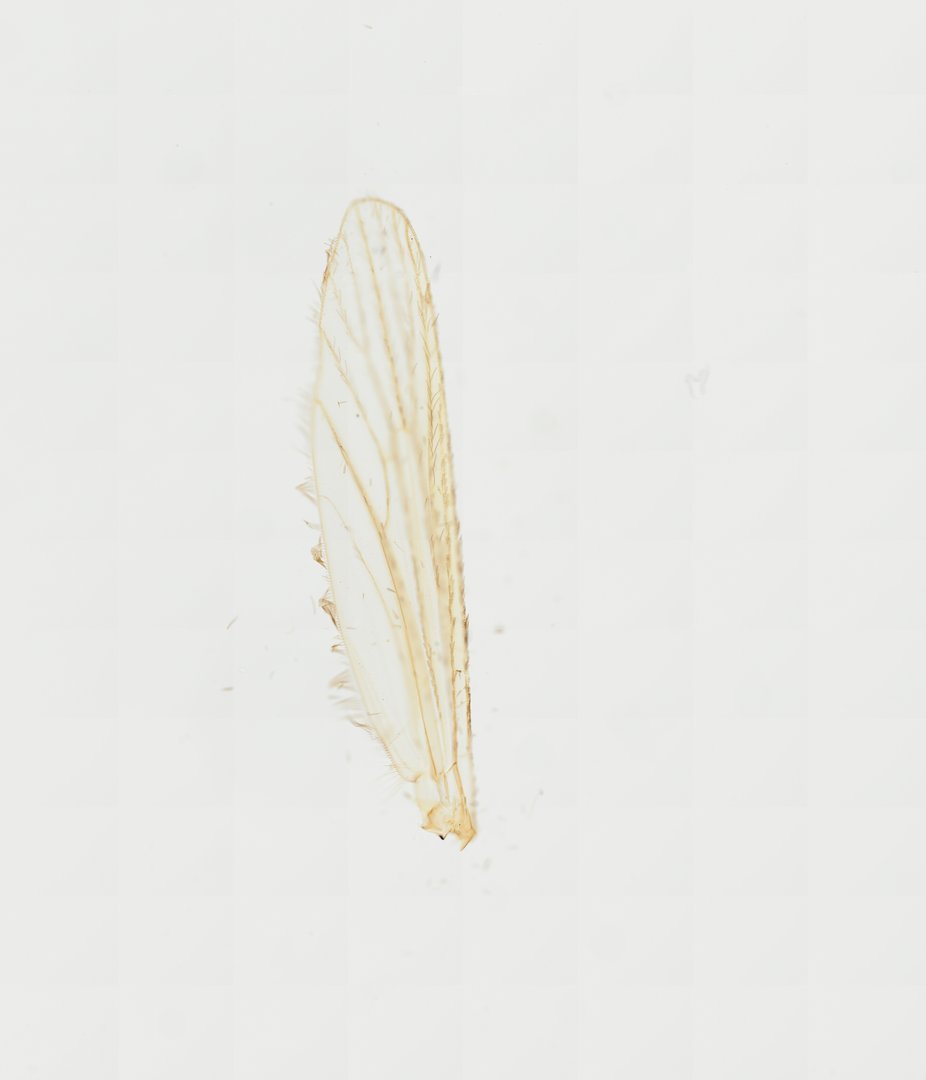
This is a mosquito wing mounted whole and unstained. Mosquito wings have scales along the veins and a fringe of scales on the edge, which is one way to tell them from other small flies.
This whole mount shows an unstained wing from a mosquito (Culex pipiens), a small fly. The wing is a long, narrow, clear sheet held up by veins that run from the base toward the tip. Tiny flat scales line the veins in neat rows, and a fringe of longer scales runs along the back edge of the wing. The clear membrane between the veins is covered with fine hairs that look like tiny dots. Scaled veins and a fringed edge help tell mosquitoes apart from other flies, and students can trace the pattern of veins from base to tip.
What to look for
- Wing membrane: The thin, clear sheet of the wing.
- Veins: Long veins running from the base toward the tip.
- Scales on veins: Tiny flat scales lined up along the veins.
- Fringe: A row of scales along the rear edge of the wing.
- Microtrichia: Tiny hairs on the membrane, visible at high power.
Questions and answers
What does a mosquito wing look like under a microscope?
A mosquito wing is long and narrow, with veins covered in tiny scales and a fringe of scales along its back edge. These scales are a key feature of mosquitoes.
How fast do mosquitoes beat their wings?
Mosquitoes beat their wings hundreds of times per second, which makes their high-pitched buzz.
- Category
- Invertebrates
- Scan magnification
- 20x
- Stain
- Unstained
Viewing this slide in class
This is a scan of a real prepared slide, not a simulation or a drawing. On StudyScope you can pan from the whole slide down to individual structures, always in focus, and measure them in real micrometers with the calibrated ruler. Present it live and every student screen follows your view and annotations. Students join with a room code on Chromebooks, iPads, or any browser, with no accounts.