House Fly Leg Under the Microscope
House Fly Leg (Whole Mount), Musca domestica
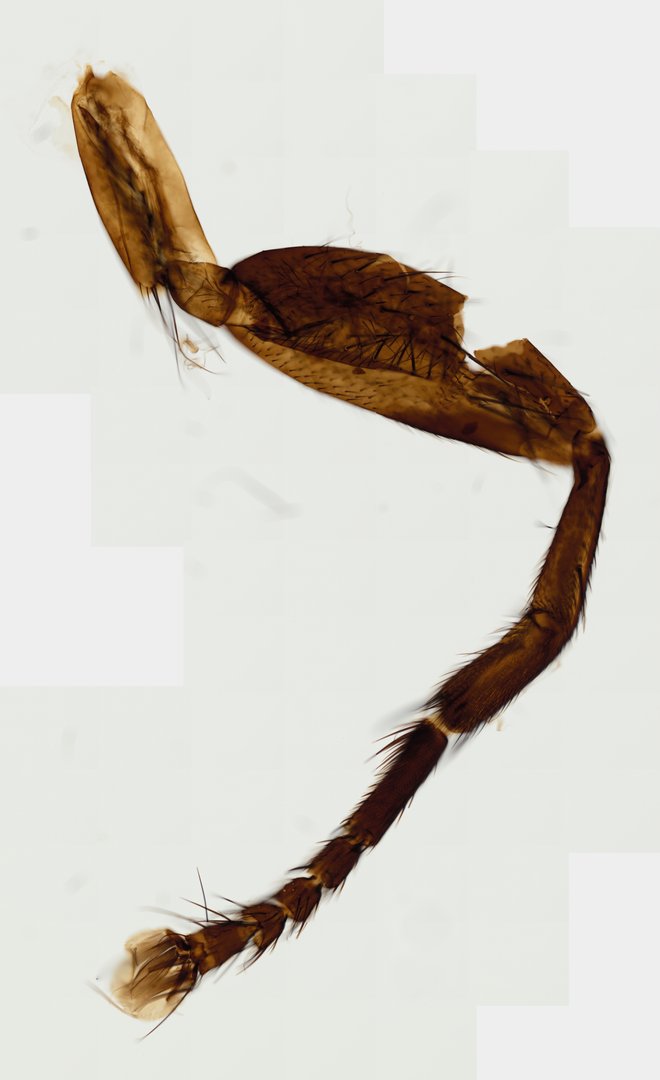
This is a house fly leg mounted whole and unstained. It shows all the standard insect leg segments, plus the sticky foot pads that let flies walk on walls and ceilings.
This whole mount shows an entire house fly (Musca domestica) leg, unstained, so its natural brown color shows. The leg is built from jointed sections: a coxa and a small trochanter near the body, a thick femur, a long tibia, and a tarsus made of five short segments. Stiff hairs called setae cover the leg and help it sense touch. At the tip are two claws and two soft pads called pulvilli. The claws grip rough surfaces, while the hairy pads help the fly cling to smooth ones like glass.
What to look for
- Coxa and trochanter: Two short segments at the base where the leg joins the body.
- Femur: A long, thick segment after the trochanter.
- Tibia: A long segment after the femur.
- Tarsus: Five small segments forming the foot, covered with bristles.
- Claws and pulvilli: A pair of claws at the tip, with soft pads (pulvilli) beneath them.
Questions and answers
How do flies walk on the ceiling?
The tip of each fly leg has two claws and two soft pads called pulvilli. The pads are covered with tiny hairs that release a sticky fluid, which lets the fly grip smooth surfaces, while the claws grab rough ones.
What are the segments of a house fly leg?
A house fly leg has a coxa, trochanter, femur, tibia, and a tarsus of five segments. The last segment carries the claws and pads.
- Category
- Invertebrates
- Scan magnification
- 20x
- Stain
- Unstained
Viewing this slide in class
This is a scan of a real prepared slide, not a simulation or a drawing. On StudyScope you can pan from the whole slide down to individual structures, always in focus, and measure them in real micrometers with the calibrated ruler. Present it live and every student screen follows your view and annotations. Students join with a room code on Chromebooks, iPads, or any browser, with no accounts.