Leech Cross Section Under the Microscope
Leech (Cross Section), Hirudo medicinalis
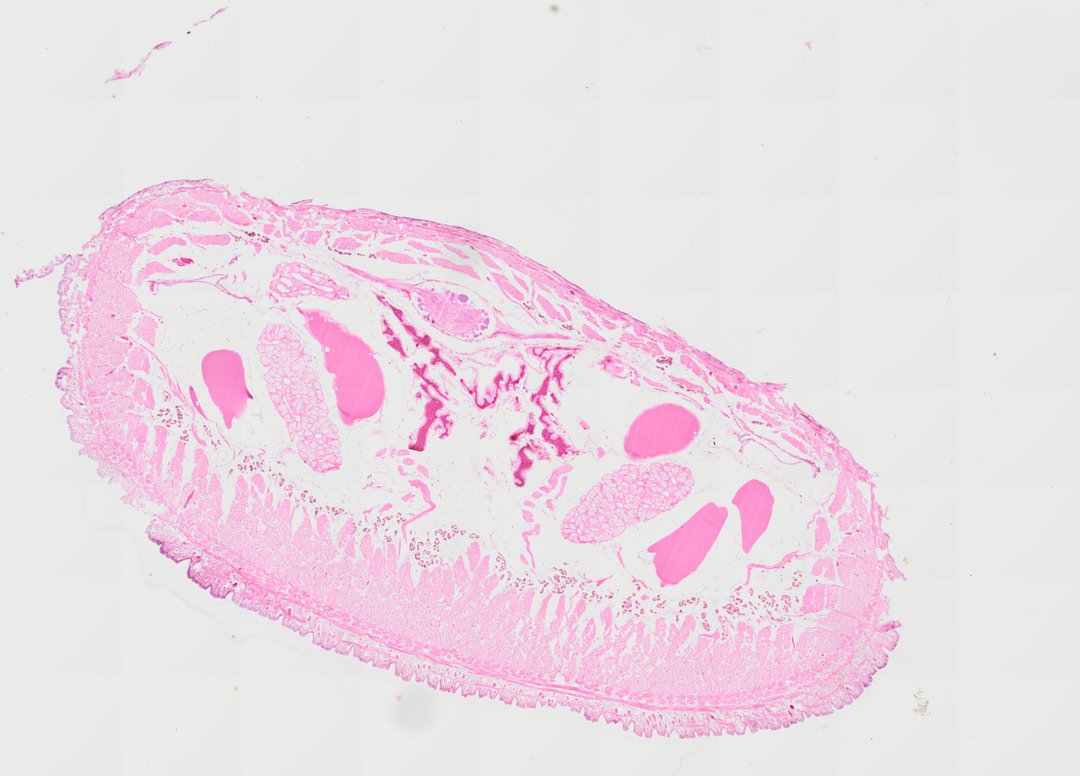
This is a cross section of the medicinal leech, Hirudo, stained with H&E. Leeches are segmented worms like earthworms, but their body is packed with muscle and tissue instead of an open body cavity.
This transverse section of the medicinal leech (Hirudo medicinalis) is stained with H&E. The body wall has a thin outer cuticle and a layer of skin cells, with thick bands of muscle underneath. Circular, long, and top-to-bottom muscles let the leech stretch, shorten, and flatten its body. Unlike an earthworm, a leech has almost no open body cavity, and most of the inside is packed with muscle and a spongy tissue called botryoidal tissue. Large pink pockets hold smooth fluid, and students can compare this layout with an earthworm cross section.
What to look for
- Cuticle and epidermis: A thin outer covering over a single layer of skin cells, with gland cells.
- Muscle layers: Bands of circular, diagonal, and longitudinal muscle, stained pink, forming a thick body wall.
- Dorsoventral muscles: Muscle strands crossing from the top to the bottom of the body, which help flatten it.
- Botryoidal tissue: Packed tissue filling much of the space inside the body wall.
- Crop: Large pouches of the gut used to store blood meals.
Questions and answers
How is a leech different from an earthworm in cross section?
An earthworm has a large open body cavity (coelom) around its gut. In a leech, the coelom is mostly filled in with muscle and tissue, and leeches have no bristles (setae) for gripping the soil.
Why are leeches used in medicine?
Medicinal leeches release chemicals in their saliva that stop blood from clotting. Doctors sometimes use them to help blood flow in reattached fingers or skin grafts.
Compare it
- Category
- Invertebrates
- Scan magnification
- 20x
- Stain
- H&E
Viewing this slide in class
This is a scan of a real prepared slide, not a simulation or a drawing. On StudyScope you can pan from the whole slide down to individual structures, always in focus, and measure them in real micrometers with the calibrated ruler. Present it live and every student screen follows your view and annotations. Students join with a room code on Chromebooks, iPads, or any browser, with no accounts.