Female Mosquito Mouthparts Under the Microscope
Female Mosquito Mouthparts (Whole Mount), Culex
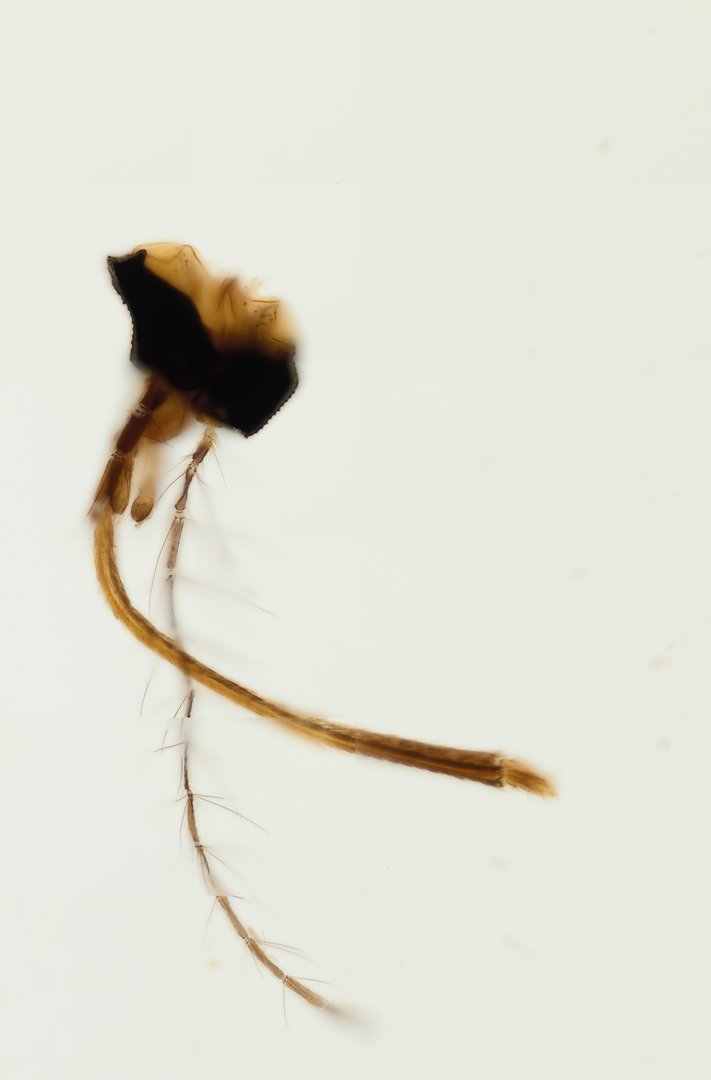
This slide shows the head and mouthparts of a female mosquito, mounted whole. Female mosquitoes have mouthparts built to pierce skin and drink blood, so this slide connects insect anatomy to disease spread.
This whole mount shows the head and mouthparts of a female Culex mosquito. The long, curved tube is the proboscis, and its outer sheath, the labium, holds six thin, needle-like stylets that pierce skin and suck up blood. Beside it are short maxillary palps, used for sensing, and the antennae. A female mosquito has antennae with only a few short hairs, while a male has bushy, feathery ones. Only female mosquitoes bite, because they need protein from blood to make eggs.
What to look for
- Proboscis: A long, thin tube extending from the head.
- Labium: The outer sheath of the proboscis that holds the needle-like stylets inside.
- Stylets: Fine piercing parts inside the labium, which may show where the sheath is split or bent.
- Antennae: Thin antennae with short, sparse hairs, unlike the bushy antennae of males.
- Maxillary palps: Segmented feelers beside the proboscis.
Questions and answers
How do you tell male and female mosquitoes apart under a microscope?
Look at the antennae. Female mosquitoes have thin antennae with sparse, short hairs, while males have bushy, feathery antennae. Only females have mouthparts that can pierce skin to feed on blood.
How does a mosquito bite work?
The labium folds back while needle-like stylets pierce the skin. Some stylets cut, one injects saliva that keeps blood from clotting, and another acts as a straw to suck blood.
Why do only female mosquitoes bite?
Female mosquitoes need protein from blood to make eggs. Males feed only on nectar and plant juices.
Compare it
- Category
- Invertebrates
- Scan magnification
- 20x
Viewing this slide in class
This is a scan of a real prepared slide, not a simulation or a drawing. On StudyScope you can pan from the whole slide down to individual structures, always in focus, and measure them in real micrometers with the calibrated ruler. Present it live and every student screen follows your view and annotations. Students join with a room code on Chromebooks, iPads, or any browser, with no accounts.