Tapeworm Cross Section Under the Microscope
Tapeworm (Cross Section), Taenia pisiformis
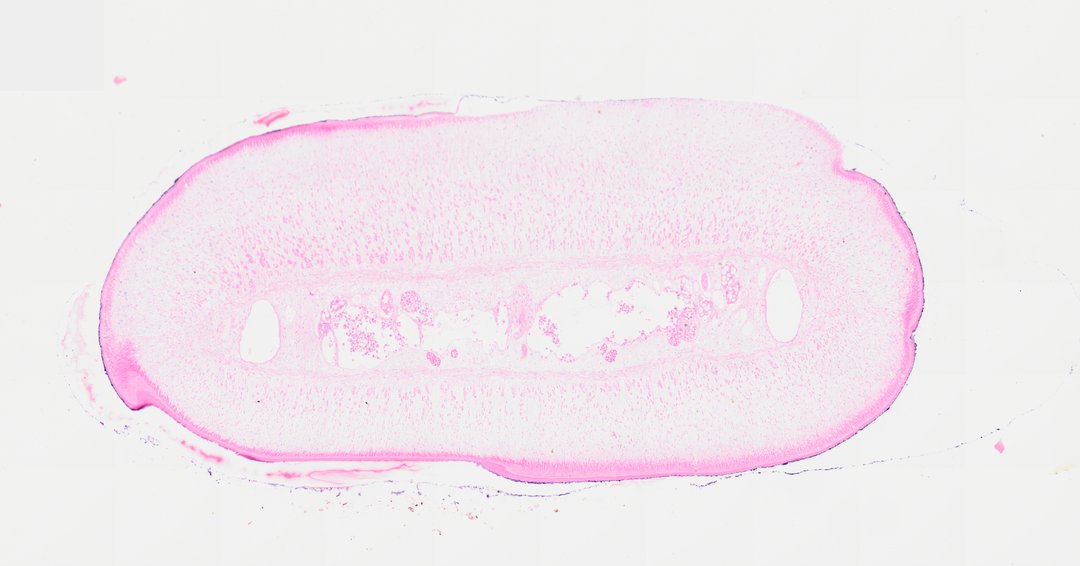
This is a cross section through a segment (proglottid) of the tapeworm Taenia pisiformis, stained with H&E. Tapeworms have no mouth or gut, so this slide shows how a parasite can be built around reproduction.
This is a cross section of a segment, or proglottid, of the tapeworm Taenia pisiformis, stained with H&E. The outer covering, called the tegument, lets the worm absorb digested food from its host, since it has no mouth or gut. Under it is a thick layer of pale, spongy tissue called parenchyma. Two large open channels near the sides are excretory canals, which carry wastes along the body. The middle holds round clusters of cells that belong to the reproductive organs, since each segment has both male and female parts.
What to look for
- Tegument: The outer covering of the worm, through which it absorbs food.
- Muscle layers: Bands of muscle just under the tegument, stained pink.
- Parenchyma: Loose tissue filling the inside of the segment.
- Excretory canals: Small round canals running along the sides of the worm.
- Reproductive organs: Structures such as testes and yolk glands filling much of the segment.
Questions and answers
Do tapeworms have a digestive system?
No. Tapeworms have no mouth or gut. They live in their host's intestine and absorb already-digested food directly through their outer covering, the tegument.
What is a proglottid?
A proglottid is one segment of a tapeworm's body. Each mature segment contains both male and female reproductive organs, and ripe segments full of eggs break off and leave the host.
What animals does Taenia pisiformis infect?
Taenia pisiformis is a tapeworm of dogs and related animals. Rabbits and hares are its intermediate hosts, and dogs get infected by eating them.
Compare it
- Category
- Pathology & Parasitology
- Scan magnification
- 20x
- Stain
- H&E
Viewing this slide in class
This is a scan of a real prepared slide, not a simulation or a drawing. On StudyScope you can pan from the whole slide down to individual structures, always in focus, and measure them in real micrometers with the calibrated ruler. Present it live and every student screen follows your view and annotations. Students join with a room code on Chromebooks, iPads, or any browser, with no accounts.